Circles and Symbols
It occurred to me, in the throes of writing The Novel (now The Short Story Collection? Idk I really have nothing in me) that I only really care about symbols and style. I take my cue from writers of theatre. Tennessee Williams used plastic symbols, images and signs which were malleable and adapted to the action onstage. They shifted in meaning. Suzan-Lori Parks does something similar with Rep & Rev (repetition and revision), writing, as it were, the same dialogue and structure again and again while altering it slightly each time. She takes this from the repeated and altered melodies in jazz. In her excellent essay “Elements of Style”, she explains how it helps her:
First, it’s not just repetition but repetition and revision. And in drama change, revision, is the thing. Characters refigure their words and through a refiguring of language show us that they are experiencing their situation anew. Secondly, a text based on the concept of repetition and revision is one which breaks from the text which we are told to write – the text which cleanly ARCS.
The revision of her characters’ dialogue means that their dialogue is constantly in reference to what it was previously, and so becomes representative of more than it is just in that moment. It becomes symbolic, and we are invited to track this change.
Perhaps I am also taken by Parks’ musings because I, too, am exhausted by the idea of a text which arcs, a structure which does not ring true in real life. There is certainly no beginning, climax, denouement. We are always repeating the same situations. Every time I need to send an email, for example, I feel like I’m going to die. Obviously I don’t and everything is always fine, but this doesn’t stop me from feeling like I’m going to die when I have to send an email or, in an altered mode, have to whatsapp my landlord. Slowly but surely, however, I feel less fear. I care less and less about pestering my landlord. No great win, though. Parks continues:
In […] plays we are not moving from A -> B but rather, for example, from A -> A -> A -> B -> A. Through such movement we refigure A. And if we continue to call this movement FORWARD PROGRESSION, which I think it is, then we refigure the idea of forward progression.
There is no simple chain of cause-and-effect. Instead, everything is symbolic. “This” reminds me of “that”. Now I see “that” differently. This is how we learn and how anything takes on any meaning whatsoever. Sure, we are progressing forward, but it is not linear. I try to do the same in what I’m writing.
In this collection of short fiction, what I’m really doing is extended Rep & Rev. This is how I plan to have some kind of cohesion. The symbols I am fixated on and which carry the most weight thematically are circular. Now I’ve been interested in circular symbols for a while, and spent a good chunk of time on them in an essay I wrote about The Catcher in the Rye. Any time I see a circle, or something round, I see stability. There is no end and no beginning (like life!). There is no cause-and-effect, no straightforward progression. Take the circular symbols of The Catcher in the Rye, when Holden watches his little sister Phoebe on a merry-go-round:
I felt so damn happy […] It was just that she looked so damn nice, the way she kept going around and around
Holden breaks from his usual erratic-depressive voice to remark on the stability of her little sister, safe on the merry-go-round. When Phoebe reaches for a ‘gold ring’, to hoist herself off the horse, Salinger refigures slightly the circular symbol. Holden sees this and accepts the inevitability of harm: ‘you have to let them do it, and not say anything. If they fall off, they fall off’. Holden does not try to trap Phoebe on the merry-go-round, to keep her static and secure, but allows her to falter, safe in the knowledge that there will always be real stability for her.
I was reminded of circles and stability last night, when I went on a tour of some of Francis Bacon’s work. There were some unfinished and some finished pieces. I thought: this man is obsessed with circles! He also sees them as stabilising, unifying elements! See:
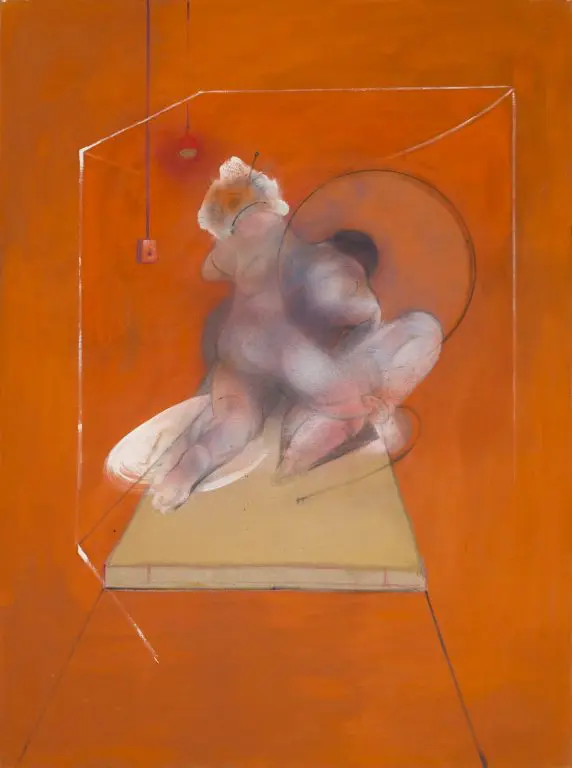
Francis Bacon, Kneeling Figure - Back View, 1982
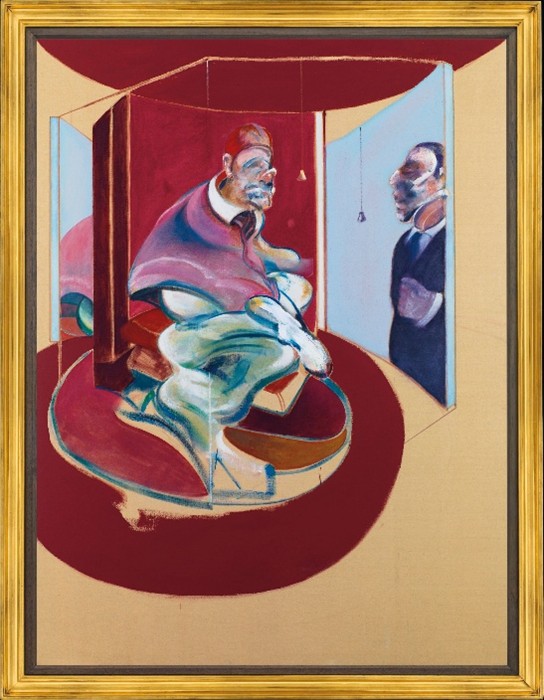
Francis Bacon, Study of Red Pope, 1962, 2nd Version, 1971
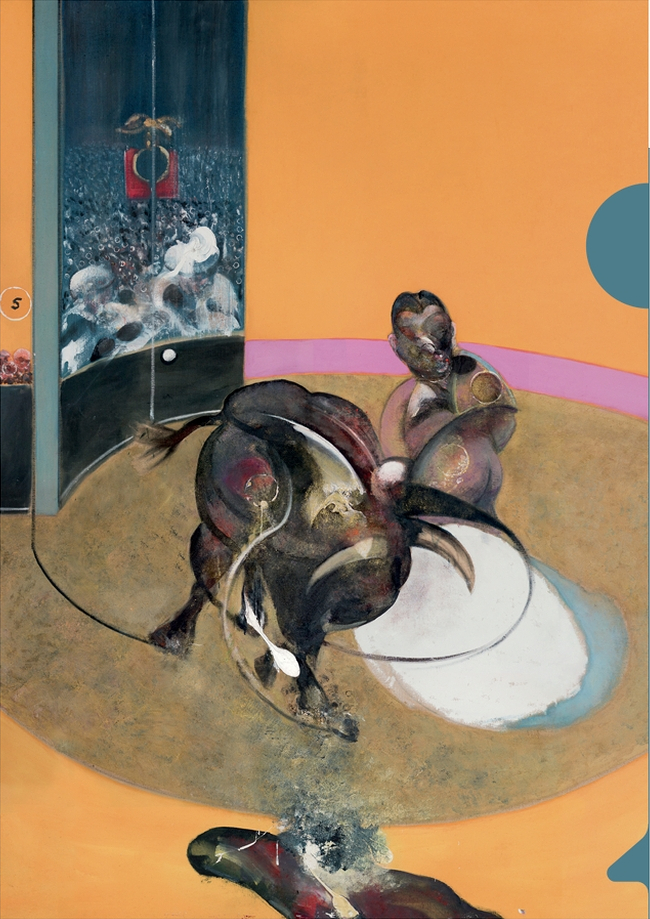
Francis Bacon, Study for Bullfight No. 2, 1969
Note how Bacon’s subjects are trapped, boarded up, surrounded by harsh and vibrant colours. Note in particular the Kneeling Figure, which I gazed at in the flesh for an extended period of time. Vague and angsty figure enclosed by a cube, stuck. What are they doing? Are they having sex? Are they in pain? Are they all there? And then in the flurry of these anxieties: the perfect, hazy circle. A sign of unity, giving harmony to the painting, giving focus, supporting the weary head.
The same for the Study for Bullfight No. 2. In all that danger, there is harmony. Bacon does Rep & Rev in his work, too.
No idea where this is going but don’t really need to know since this is just a blog post. All my stories will be revisions of the same story. I’m incapable of writing anything with a real “arc” because I don’t care. Think I’m obsessed with circles. Stay tuned for a lot of circles and repetition in my stories! Will probably change my mind and keep working on The Novel though.
- I 15 August 2025